About Sentosa Education & Arts FoundationHistoryDuring the Japanese occupation (1942-1945), all Dutch and Western language schools were banned! Only schools with Indonesian and Chinese language instruction are permitted to operate by the Japanese. This happened on August 1, 1942.Entering the phase of Indonesian independence, in 1950, the Indonesian government stopped subsidies for Chinese-medium schools. However, Indonesian citizens of Chinese descent can still continue their education there. In 1957, the Indonesian government's supervision of Chinese-medium schools began to appear rigid along with the outbreak of regional rebellions in Indonesia. On November 6 1957, the defense minister Djuanda issued a regulation prohibiting Indonesian citizens from entering foreign schools (read: schools with Chinese language instruction). All teachers in Chinese schools must obtain permission from the ministry of education, new schools may not be established, all books used in Chinese schools must be approved by the minister of education. On November 20, 1957, the minister of education issued an annex strengthening this regulation. This situation clearly seems to have caused a change in the disposition of the world of education in Chinese-medium schools. In November 1957 there were 2000 Chinese language schools with 425,000 students and 250,000 of them were Indonesian citizens. By July 1958, there were only 850 Chinese-medium schools with an enrollment of 150,000 foreign Chinese children. Another 1100 Chinese-language schools were converted into Indonesian national schools.On October 16 1958, Army Chief of Staff General Nasution banned the operation of all schools that had ties to Taiwan. As a result, almost 50% of these schools were taken over by the Indonesian authorities and converted into Indonesian language schools. As we all know, in 1965 the PKI rebellion occurred. This event completely changed the educational situation in Indonesia. On July 6, 1966, the minister of education issued a regulation closing all Chinese-medium schools. As a result of this regulation, a large number of students are not accommodated due to school shortages! In this case, the government detected that it would be dangerous if many students were unable to attend school. The government anticipates that subversives will not use this opportunity to influence students who cannot attend school. So in early 1968, the government issued a regulation called presidential regulation No B 12/Pres/I/1968 which allowed the establishment of schools sponsored by private groups within the Chinese community. This project is called the Special School National Project (SNPC). So in 1969 two SPNC schools were established in Jakarta. In 1973, 35 SPNC schools were established in Sumatra. The SPNC grew and the Mashuri culture passed regulations that abolished the SNPC program. According to him, the transition period for Chinese students has been sufficient and complete. As a result, SNPC was transformed into a private national school. In 1968 the name SENTOSA was used and the Sentosa private school was established. The SDN 5 school building, which is next to Tapekong Pemangkat, was originally the fourth branch of the Chinese school (hakka: thi si kau). This school building is in the form of an elongated warehouse which is then divided into classrooms. Meanwhile, the Chinese school in front of the Fa Kong Ti (temple) which is now a company is the central or main Chinese school and is the largest of all the Chinese schools in Pemangkat. Later this school was dismantled and turned into a company by the government. All the students moved to the Tio Chiu school building (sip min hok thong: students who don't have SBKRI), which is now SDN 7. Because there were too many students, the students boarded at the Chinese school which is now SDN 5 and SDN 3. Later, the building Thi Si Kau school (which later became SDN 5) was demolished and rebuilt with cement. (Mrs. Sutjiawana, as one of the students there, also experienced this historical journey. As students, they were happy because the building in the form of a plank warehouse had been rebuilt with cement).The emergence of Sentosa SchoolBased on the brief history outlined above, we can find that the national education situation that occurred at that time also spread to areas including the city of Pemangkat which had a fairly large ethnic Chinese population. As a result of the 1966 regulation where the government closed all Chinese schools, as a consequence, ethnic Chinese in Indonesia (read: Pemangkat) could not go to school. They also cannot enter state or private schools (owned by missions or churches) because they do not have SBKRI. In this case, the parents and their children are considered to have no clear origins.Therefore, in accordance with the government's concerns, in 1968 the school "Sip Min Hok Thong (ji min xue xiao: 藉民學校 (does not have SBKRI) was founded with the name SENTOSA school. This school was founded to accommodate all Chinese students who could not Chinese school in Sentosa because it was closed. Those who had SKBRI could attend private or public schools in Sentosa. The teachers consisted of Chinese and native teachers , in Pemangkat itself there are around 4 Chinese schools, namely: Thai Hok Thong: Zhong Hua Xue Xiao: 中華學校 (center), Chau Chiu Hok Thong; Xiao (branch). Later all these schools were taken over by the government.At the beginning of its establishment, the "Ji Min Xue Xiao" school, namely Sentosa, they took place in the former "Chou Chuo Xue Xiao" school on church street (now occupied by SDN NO 7). Several years later there was a suggestion from the head of the Pemangkat education service, who at that time also had an office in Sentosa. He proposed to nationalize Sentosa, provided that it was labeled as a state company but that it would still be managed by a private foundation. In this way, Sentosa gets teacher assistance from the government. This proposal was approved. However, several years later, the government intervened and wanted to take over leadership at Sentosa schools. At that time, Sentosa already had a school principal who had served for a long time, but the government sent another principal. As a result, at Sentosa there are two principals. To overcome this, it was decided that one principal would handle internal problems and the other would handle external problems.Approaching 1979, the government planned to take over all of Sentosa's schools and rebuild Sentosa's schools because they were going to be rezoned. In this way, the government fired all private teachers. In other words, at that time in Sentosa there were two managements, namely: state and private. In other words, all private administrators must leave "Sentosa". In this case, the government allows students in grades 1, 2 and 3 with a total of around 300 students to be brought. Private Sentosa school administrators are allowed to bring all the benches and chairs because they belong to the foundation. So the separation process begins. In this case, a number of teachers united and founded the Sentosa Education and Arts Foundation. There are three Chinese teachers and 4 native teachers who founded the Sentosa Foundation. However, in its development, the active members of the Foundation were only three Chinese teachers, namely Mrs. Sutjiawana/Chin Lau Shi, Mrs. Serena/Li Lau Shi and Mrs. Hernawati as well as a native teacher who served as school principal, namely the late. Mr. Arsyi Marsena. Deputy chairman of the late foundation. Mr H. Bujang was also involved indirectly. Thus, Sentosa left its original location and moved to a new location. Meanwhile, Sentosa Lama became SDN 07.Since Sentosa does not yet have a building, for the time being, all students are left at SDN 5 for approximately one year (This school also belongs to a Chinese school which was taken over by the government; it is located in front of Ta Pe Kong). When the government demolished the entire Sentosa school building, all the wood was returned to the Sentosa Foundation except the land. Thus, Sentosa had to look for a place to build a new school using the wood that was removed from the old Sentosa site. The next task is to find a place and funds for the construction of the Sentosa school building. Development funds were obtained from loans from Foundation members and donations from donors in the city of Pemangkat. The construction site chosen was the location of land on Jalan gg Abadi Church which at that time was still a wilderness. The construction of the new Sentosa building only succeeded in establishing three local buildings. Thus, the educational process at Sentosa began. The first building owned by Sentosa is located in the middle of the field between the new basketball court and the old court. Several years later, Sentosa managed to buy two pieces of land so that the whole thing became what it is today.It is also worth noting that, in conditions of inadequate infrastructure, in 1993, the Foundation decided to establish SENTOSA Middle School. This was due to the demands of the situation and conditions at that time. A large number of SENTOSA Elementary School students. After completing their education they do not continue to a higher level. Some of the reasons put forward are; don't have the money to enroll in another school, reluctant to move to a new situation again, etc. Therefore, to reduce the number of school dropouts, Sentosa took the liberty to open junior high school classes. This continues and from year to year, quite a lot of students are accommodated. Finally in 2007, with the infrastructure in good condition and at the urging of junior high school students and a number of teachers, the Foundation again made an important decision, namely the plan to establish Sentosa High School. So with various considerations, Sentosa High School was finally founded and it was quite encouraging that the students who registered were quite large and varied. In the new/first academic year, Sentosa High School can enroll as many as 45 students. In 2011, the foundation reopened the Sentosa Kindergarten unit to become 4 units.1998 was an important year for Sentosa because in that year the Foundation was renewed with various considerations: the inactivity of several foundation members, the atmosphere in the city of Pemangkat as a result of inter-ethnic riots which resulted in the head of the Sentosa Foundation having to move outside the city of Pemangkat. Finally, after various considerations and after going through a series of meetings, it was decided to re-organize the Foundation. The renewal of the Foundation was carried out by making fundamental changes to the articles of association and bylaws with a notarial deed. Notary Deed no. 86 dated 14 August 1979 was updated with notarial deed no. 4 dated 18 August 1999. The changes also touched the management of the Foundation. So since then the Foundation has made major changes and the most visible is the contact with a number of donors. Rejuvenation and more regular management are being carried out at Sentosa schools.Human resource development is carried out by appointing new elementary and middle school principals, and what is more important is the existence of a number of contacts with donors and also assistance from the government. As a consequence of these contacts, Sentosa received a number of very significant assistance to carry out physical development. The first construction began with assistance from the government and with funds from the Foundation. Based on government donations and Foundation funds, a teacher's office, four classrooms, student and teacher toilets and a canteen were built. In 2004, Mr. Chang Bui Fung and his family, namely his mother and sisters, agreed to be the sole donors to build a two-story building with a capacity of 6 classrooms. In the following year, Mr. Arifin Iskandar from Singapore agreed to donate 20 computers and build four classrooms. In 2006, the Indonesian Teo Chew Association from the Jakarta Permai School Foundation was pleased to provide a donation in the form of a two-story building with a capacity of 6 rooms. At the same time, Mr Chang Bui Fung and his family were pleased to make a donation in the form of building a sports field. Since the field and classrooms are very close, several donors from Jakarta were willing to provide donations in the form of iron grilles along the classrooms. Mr. Arifin Iskandar from Singapore was again pleased to provide donations in the form of renovating student toilets, building toilets for kindergarten students and several donations of infrastructure for education.However, it is also appropriate for us to say that long before the construction of the Sentosa buildings, there were a number of initial donors who became our partners and friends in building Sentosa. On this occasion, we would like to express our thanks to Brother Kok Kim Fat who helped Mrs. Sutjiawana and Mrs. Hernawati seek donations from the Pemangkat Community. Mrs. Sutjiawana and Mrs. Hernawati went around the city of Pemangkat looking for donations for the construction of the Sentosa school. And Mr Kok Kim Fat helped contact Pemangkat entrepreneurs so that they would donate to the construction of the Sentosa school. At the beginning of Sentosa's founding, there were no fields and what was visible was a dirt yard which was often muddy and dirty when it rained. So Brother Chin Lian Shin helped with the field construction process. The process of building this field could not be completed completely due to one or two reasons, so the construction of this field was continued by Mr. Lu Sau Kiun.Currently, Sentosa has a number of buildings and fields that are sufficient to hold the learning process. However, the Foundation still has to develop human resources and infrastructure to support the learning process. One of the things that really worries us is the teachers/staff. For the future, Sentosa is working on having permanent Foundation teachers and for this a certain amount of funding is needed. Apart from that, there are also funds for the procurement of infrastructure. On the other hand, many Sentosa students come from poor families. In fact, there are a large number of graduates who do not pay tuition fees until they graduate but we still give them diplomas. This condition makes it difficult for foundations to develop themselves, especially in terms of funding. In other words, Sentosa has many students who cannot afford to pay and this must be covered by the Foundation. In this case, non-binding donations from benefactors are truly a blessing for the Foundation.VisionThe Sentosa Foundation was founded by a group of people who care about education to participate in elevating and especially enlightening human dignity through education that prioritizes academic excellence and humanistic values. Education at Sentosa is primarily based on human values, nationalism and the spirituality of "Option to the poor".MissionTo realize an educational vision that combines academic excellence and humanistic values. Sentosa establishes itself as a critical, open, innovative, creative and faithful educational institution.Legal BasisNotarial Deed no. 86 dated 14 August 1979 was updated with notarial deed no. 4 dated 18 August 1999.
RI KEMENHUNKAM Decree No AHU-0013046.AH.01.04 of 2023Symbols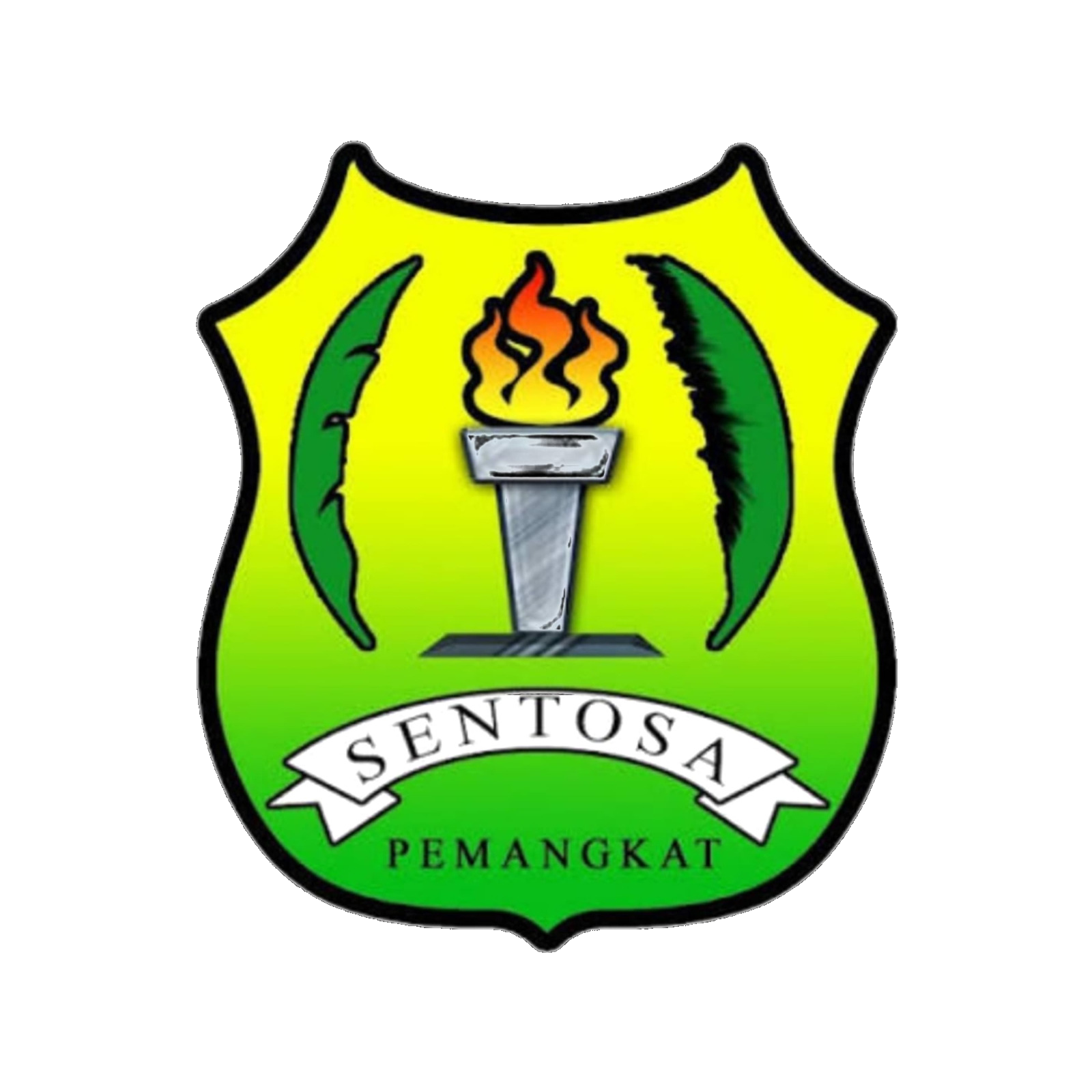 Five-sided symbol: symbolizes Pancasila with its five principles
The burning torch: symbolizes the never-ending passion for learning from Sentosa teachers and students
Open book under a torch: symbolizes the world of education
Two banana leaves: symbolize self-determination; Banana leaves seem simple but are very strong and can be used for many useful things, banana leaves also symbolize local agricultural products
The name Sentosa: symbolizes the school's identity
Pemangkat: symbolizes the place where the school works
Yellow and green: symbolize the fertility of the Indonesian earthAnthem
Five-sided symbol: symbolizes Pancasila with its five principles
The burning torch: symbolizes the never-ending passion for learning from Sentosa teachers and students
Open book under a torch: symbolizes the world of education
Two banana leaves: symbolize self-determination; Banana leaves seem simple but are very strong and can be used for many useful things, banana leaves also symbolize local agricultural products
The name Sentosa: symbolizes the school's identity
Pemangkat: symbolizes the place where the school works
Yellow and green: symbolize the fertility of the Indonesian earthAnthem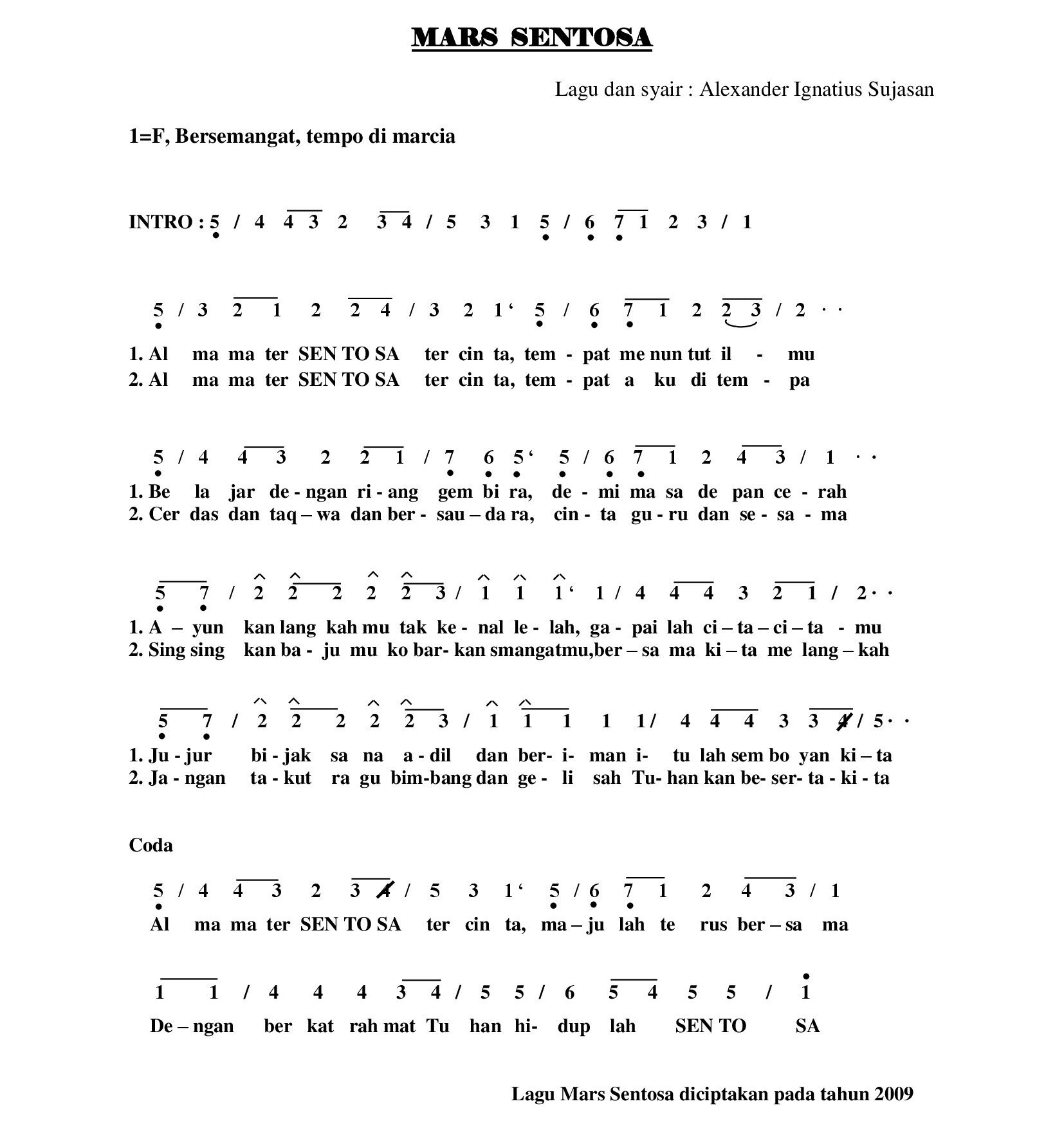
Five-sided symbol: symbolizes Pancasila with its five principles
The burning torch: symbolizes the never-ending passion for learning from Sentosa teachers and students
Open book under a torch: symbolizes the world of education
Two banana leaves: symbolize self-determination; Banana leaves seem simple but are very strong and can be used for many useful things, banana leaves also symbolize local agricultural products
The name Sentosa: symbolizes the school's identity
Pemangkat: symbolizes the place where the school works
Yellow and green: symbolize the fertility of the Indonesian earthAnthem